
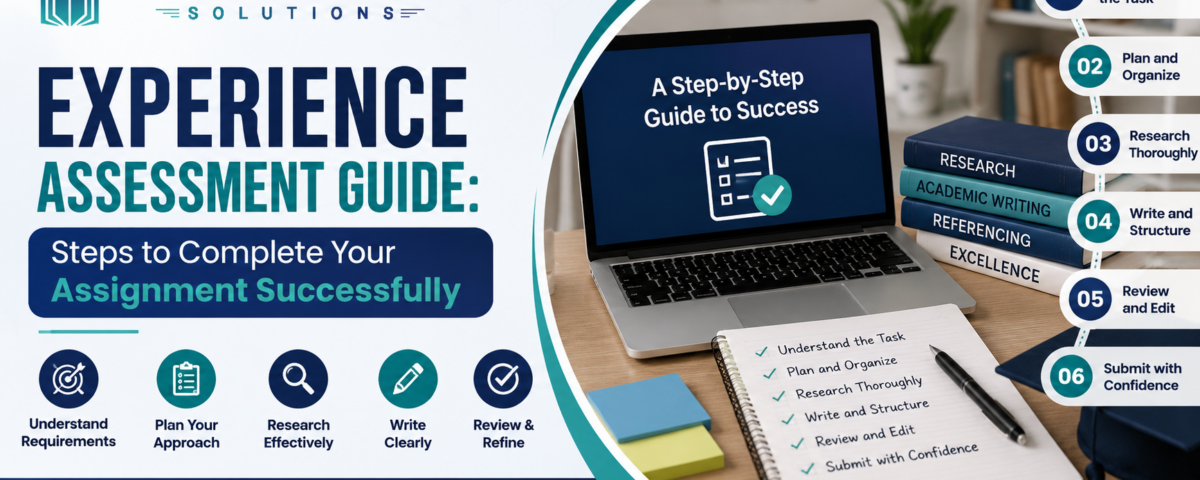
Experience Assessment Guide: Steps to Complete Your Assignment Successfully
In the UK, experience assessments are an integral part of university education, particularly in areas such as nursing, healthcare, business management, education, social work, hospitality, psychology, and engineering. An experience assessment is different from a traditional essay. Students are asked to reflect on a real-life situation, workplace placement, internship, project, or learning activity and explain what they learnt from the experience.
Many students struggle with reflective assignments as they are unsure how to balance personal experience with academic analysis. “Just telling what happened isn’t enough. Universities in the UK expect students to think critically about their experiences, relate them to appropriate theories, and explain how the learning will impact their future academic or professional practice.
This Experience Assessment Guide walks you through the process of successfully completing an experience assessment assignment. If you’re struggling to understand the assignment brief, need help with structuring your report, or want to avoid common mistakes, this guide will help you to produce a well-organised and high-scoring submission.
What Is an Experience Assessment?
An experience assessment is an academic assignment that requires students to analyse a personal or professional experience through critical thinking and reflection. The goal is to show how an experience has shaped your learning, problem-solving skills, and professional growth.
Experience assessments are often based on:
- Work experience placements
- Internships
- Clinical practice
- Lab sessions
- Group Activity
- Volunteer work
- Field Trips Simulations
- Training for Professionals
Instead of just telling what happened, you should tell why the experience was important and what you learned from it.
What is the significance of experience assessments?
Experience assessments are used by universities to evaluate practical learning in addition to academic knowledge. Assignments challenge students to critically think about real-life situations and apply theoretical concepts in a meaningful way.
Some of the major advantages are the following:
- Enhances critical thinking skills
- Enhances reflective writing skills
- Links theory to practice
- Improves professional development
- Supports self-awareness.
- Develops skills to solve problems
- Gives confidence for future profession
- Promotes lifelong learning
These skills are valued by employers and professional organisations in many industries.
Categories of Experience Evaluation Tasks
Depending on your course, you may be required to do different types of reflective assessments.
Reflection Papers
A reflective essay is a personal learning experience, which is analysed and linked to theories in academia.
Reflective Report
These reports are formal in structure and are often a requirement in business, healthcare, and engineering programmes.
Placement Report.
Students explore the experiences gained through professional placements or internships.
Clinical Reflection Tasks
Health and nursing students evaluate their experiences caring for patients confidentially.
Project Review
Students reflect on their role, challenges, and achievements on academic or workplace projects.
How to Complete an Experience Assessment One Step at a Time
Step 1: Carefully read the assignment brief
Know what your lecturer wants before you start writing.
Beware of:
- Outcomes of Learning
- Words number
- Evaluation standards
- Citation style
- Deadline for submission
Highlight important instructions to make sure nothing is missed.
Step 2: Pick the right experience
Choose a relevant experience for your course that is detailed enough to enable critical analysis.
Good examples are:
- University project completed
- Collaborating with a team
- Handling a Difficult Customer
- Experience of placement
- Dealing with a workplace problem
Choose an experience that taught you something worthwhile.
Step 3: Share the experience
First, describe the situation clearly.
Add:
- Where it took place
- Picture of who
- Your work
- The purpose
- The resulting
Keep this section short, as most of the marks are for analysis, not description.
Step 4: Consider What Happened
Ask yourself questions like:
- What was good?
- What were my obstacles?
- How did I reply?
- What could have been better?
This stage shows self-awareness and critical thinking.
Step 5: Bridge Theory and Practice
One of the most important parts of an experience assessment is making the connection between your experience and academic concepts. You can use models like this.
Gibbs Reflective Cycle
- Description
- Feelings
- Evaluation
- Analysis
- Conclusion
- Action Plan
Kolb’s Experiential Learning Cycle
- Concrete Experience
- Reflective Observation
- Abstract Conceptualisation
- Active Experimentation
Grounding your argument in established theories will boost your academic writing and show a greater depth of understanding of the subject.
Step 6: Analyze Your Learning
Don’t just say what happened; say what you learned from it.
Discuss:
- New knowledge acquired
- Skills learned
- Errors committed
- What we learned
- Career advancement
It is a critical analysis that differentiates a good reflective assignment from an average one.
Step 7: Talk About Improvements
Describe how the experience will affect your future behaviour.
For instance:
- Better communication skills
- Improved time management
- Additional Leadership Skills
- Improved teamwork
- More confidence
This means that you are always learning and growing in your profession.
Step 8: Organise Your Assignment
A typical experience assessment structure includes the following.
Introduction
Introduce the experience and explain the purpose of the assessment.
Description
Provide background information about the experience.
Reflection
Evaluate what happened and analyse your actions.
Application of Theory
Connect your experience with academic literature and reflective models.
Learning Outcomes
Discuss the knowledge and skills gained.
Conclusion
Summarise the key lessons and explain how the experience will influence your future practice.
Step 9: Review and Proofread
Before submitting your assignment:
- Check grammar and spelling.
- Verify Harvard referencing.
- Ensure logical flow.
- Remove repetitive information.
- Confirm that learning outcomes are addressed.
- Review formatting.
A well-presented assignment creates a positive impression.
Common Mistakes to Avoid as a Student
Many students lose marks due to mistakes that could have been avoided.
Some common mistakes are the following:
- Just reporting on events without analysis
- Neglecting reflective models
- Not backing up ideas with academic literature
- Poor structure
- Bad referencing
- Informal writing
- Word count exceeded.
- Failure to link experience to the learning outcomes
Avoiding these mistakes will help you improve your assignment a lot.
How to Write a High-Scoring Experience Assessment
In order to make a good assignment.
- Know the Marking Scheme.
- Select a meaningful experience.
- Critical reflection, not description.
- Back up your discussion with academic sources.
- Use recognised reflective models.
- Referencing: Harvard-style referencing.
- Employ a formal academic writing style.
- Proofread carefully before submitting.
These practices lead to a holistic and academically sound reflective assessment.
Looking for Help with Your Experience Assessment Assignment?
Writing an experience assessment requires a more sophisticated kind of analysis than just telling what happened to you. Students will be required to show evidence of critical thinking, academic analysis, and the ability to connect practical experience with established theories. Professional academic help can be a great way to get extra assistance to improve the structure of your assignment, your reflective writing, referencing, and overall presentation.
Online Assignment Solutions – Expert Assignment Help UK, Online Assignment Help, Coursework Help UK, essay writing services in the UK, University Assignment Help, Academic Writing Services UK, Dissertation Help UK, and Student Assignment Help UK. All assignments are prepared as per the standards of UK universities with a free Turnitin report, a free AI plagiarism report, affordable prices, and the support of experienced subject specialists.
Final thoughts
An experience assessment is a great way to demonstrate how practical experiences contribute to academic and professional development. So, if you have a structured approach and think critically and relate your experiences to relevant theories, you can write a well-organised assignment that meets university expectations. Remember that the best experience assessments consider not only what happened but also what was learned and how that learning will influence future practice.
FAQ’s
1. What is an experience assessment task?
Ans: An experience assessment is a reflective academic activity in which students evaluate a personal or professional experience, reflect on what they have learnt, and link their observations to relevant academic theories.
2. What is the most widely used reflective model in UK universities?
Ans: One of the most used models is the Gibbs Reflective Cycle, as it gives a structured way to describe, evaluate, analyse, and improve future practice.
3. How does an experience assessment differ from an essay?
Ans: An essay is largely about academic theories and evidence. An experience assessment is a blend of personal experience and critical reflection, along with theoretical analysis.
4. What should you not do when writing an experience assessment?
Ans: Do not just describe events without analysis, ignore reflective frameworks, use informal language, poorly reference, and do not explain what you learnt from the experience.
5. Can I get professional help with the experience assessment assignment?
Ans: “Yes. We offer professional academic support services to help you with reflective writing, assignment structure, referencing, proofreading, and academic editing. Our academic editing services make sure your work is up to the standard required by UK universities.
