
Management Assignments: A Complete Guide for UK University Students
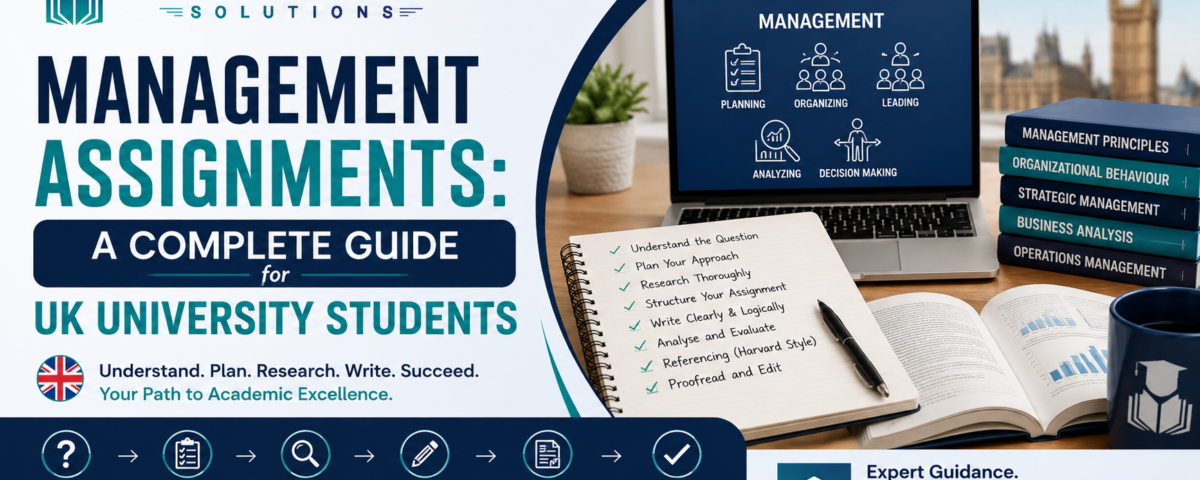
Management is one of the most popular degree programmes offered by UK universities. During your academic career, you will be writing different management assignments irrespective of what you are studying, be it business management, strategic management, human resource management, operations management, marketing management, international business, or an MBA programme. These assignments are designed to test your ability to analyse business situations, apply management theories, solve organisational problems, and make evidence-based recommendations.
Management assignments are different from traditional essays, where students are required to combine knowledge with practical business applications. Lecturers expect students to show critical thinking, independent research, problem-solving skills, and the ability to evaluate real-world business scenarios using recognised management frameworks. Many students struggle with complex case studies, business reports, and strategic analysis because these assessments require more than just explaining theories.
This comprehensive guide will give you all the information that UK university students need to know about management assignments, including understanding the different types of assignments, structuring your writing effectively, familiarising yourself with common management models, avoiding common mistakes, and getting practical tips that will help you achieve better grades.
What is a management assignment?
Management assignments are academic assessments in which students have to analyse organisations, management practices, leadership strategies, business operations, or organisational challenges using academic theories and practical evidence.
The assignments help students develop the analytical, decision-making, leadership, communication, and strategic planning skills they need in the business world.
Typical topics include the following:
- Management: Strategic Management
- Operations Management Human Resources Management
- Project Management Marketing Management
- International Business, Organisational Behaviour, Leadership and Change Management Financial Management
Often, assignments require students to think about real companies and suggest feasible solutions as per academic research.
Why Are Management Assignments Important?
Management assignments help students to develop their professional careers by applying theoretical knowledge to real business situations.
These assignments help students to develop:
- Critical Thinking Skills
- Decision-making skills
- Leadership skills
- Methods of problem-solving
- Research skills
- Corporate communication
- Strategic planning
- Thinking critically
Employers love these skills because they show you’re able to solve complex organisational problems and make good business decisions.
Management Assignments: Types
Academic assessment in management courses takes various forms.
Case Study Assignments
Students look at real organisations, spot business problems, and suggest practical solutions.
Reports on Business
The reports address themes of organisational performance, management strategies, financial performance, or operational challenges.
Essays
Management essays cover theories, concepts, leadership styles, or current business issues and are supported by academic literature.
Research Papers
Students use academic journals, business reports, and industry research to explore management issues.
Reflective Assignments
Reflective reports are used to assess personal experience gained from internships, leadership activities, and group projects.
Dissertation
Final year and postgraduate students conduct independent research into management-related topics.
Common Topics for Management Assignments
- Strategic Management
- Business Planning
- Leadership
- Organisational Behaviour
- Human Resource Management
- Operations Management
- Supply Chain Management
- Project Management
- Business Ethics
- Corporate Governance
- Innovation Management
- Risk Management
- International Business
- Entrepreneurship
- Marketing Strategy
Students are required to examine these topics using current business examples and academic theory.
A Step-By-Step Guide On How To Write A Management Assignment
Step 1: Know the Assignment Requirements
Read the assignment brief carefully first.
Determine:
- Educational Outcomes
- Criteria for evaluation
- word count
- Reference style
- Deadline to submit
Knowing what is required keeps you focused throughout the whole writing process.
Step 2: Do Your Research
High-quality management assignments are built on credible evidence.
Among the useful research sources are:
- Journals, academic
- Textbooks business
- Industry reports
- Government documents
- The company’s annual reports
- Market research reports
- Professional business websites
Never forget to reference recent and reliable sources for your claims.
Step 3: Develop a logical structure
A good structure makes an assignment easier to read and shows that you are being academic and professional. A typical management assignment is about that.
Introductory
The assignment will describe the topic, its objectives, and scope.
Body Text
Clearly present analysis using research and management theories under clear headings.
Suggestions
Offer practical, evidence-based business solutions.
Summary
Summarise the main findings without adding extra information.
Step 4: Use of Management Theories and Frameworks
An important part of a management assignment is the application of recognised business models.
Typical frameworks include the following:
- SWOT analysis
- PESTLE Analysis
- Porter’s Five Forces
- The McKinsey 7S Framework
- Balanced Scorecard
- Ansoff Matrix, BCG Matrix, Value Chain Analysis
- Stakeholder Analysis for Kotter’s Change Management Model
Using these frameworks demonstrates critical thinking and professional business analysis.
Step 5: Use Real Examples of Businesses
Support your discussion with examples of real organisations.
You might analyse:
- Apple, Amazon, Tesco
- Microsoft, Unilever, Starbucks
- Google Rolls-Royce, British Airways Tesco PLC
Examples from real life make your arguments more convincing and relevant.
Step 6: Analyze, not describe
A lot of students lose marks just by explaining management theories.
Instead, assess:
- Why the strategy worked
- Strengths and weaknesses of the business
- Market opportunities
- Risks and challenges
- Other Solutions
- Long-term impact on business
Critical analysis requires higher-order academic skills.
Step 7: Proper Referencing
Most UK universities require Harvard referencing.
Make sure that:
- All sources are properly credited.
- Includes bibliographical references and in-text citations.
- The reference list is done.
- All borrowed ideas are cited.
Good referencing prevents plagiarism and improves the academic quality of your work.
Step 8: Revise Your Assignment
Go over your work before submitting it.
Exam:
- Grammar
- Spelling
- Formatting
- Referencing
- Clarity
- Flow of ideas
Proofreading is the best way to improve the quality of your assignment.
Mistakes Students Should Not Make
Students lose points for simple errors.
They are:
- Misunderstanding the question of the task
- Bad research
- poorly constructed
- Absence of critical appraisal
- Too much descriptive writing
- References missing
- Arguments that are not supported
- Grammar errors Plagiarism
- Disregarding marker criteria
Avoiding these errors will greatly improve the quality of the assignment.
Top Management Assignment Writing Guidelines
For improved academic performance.
- Read the whole of the assignment brief.
- Engage in some serious academic research.
- Use recognised management frameworks.
- Back up every argument with evidence.
- Use examples from business today.
- Promote critical thinking.
- Use Harvard referencing.
- Proofread before submitting.
These are the hallmarks of solid academic writing and professional business analysis.
Key Management Frameworks Every Student Should Know
Common business models for university assignments include the following.
SWOT analysis of the company
Analyses the Strengths, Weaknesses, Opportunities, and Threats affecting an organisation.
PESTLE Analysis
Reviews the political, economic, social, technological, legal, and environmental factors that impact business performance.
Porter’s Five Forces
Analyses industry competitiveness and market attractiveness.
McKinsey 7S Model
Measures the effectiveness of the organisation against seven interrelated elements.
Balanced Scorecard
Measures organisational performance other than financial outcomes by considering customers, internal processes, learning, and growth.
If students are aware of these frameworks, they will be able to produce better and more analytical assignments.
Stuck with your management assignment?
Management jobs often involve detailed research, strategic analysis, and the application of complex business theories. If you are having problems with case studies, reports, essays, or dissertations, professional academic help can help you write high-quality work as per university standards.
Online Assignment Solutions is a provider of expert management assignment help, business management assignment help, strategic management assignment help, MBA assignment help, assignment help in the UK, online assignment help, coursework help in the UK, research paper help in the UK, essay writing services in the UK, and dissertation help in the UK. We provide plagiarism-free content and are customised to the UK university standards, with a free Turnitin report, a free AI plagiarism report, and affordable prices. All the assignments are written by experienced subject experts.
Summary
Management assignments are critical in developing the analytical, leadership, and decision-making skills needed in today’s business landscape of today. Understanding the assignment brief, carrying out extensive research, applying recognised management models, and supporting arguments with evidence will enable students to produce work that meets the expectations of UK universities. Whether you are preparing a business report, a case study, a dissertation or an MBA project, a structured methodology will improve your academic results and professional knowledge.
FAQs
1. What are management assignments?
Ans: Management assignments are academic exercises that require students to analyse business organisations, evaluate management strategies, apply business theories, and make evidence-based recommendations.
2. Which management models should I follow in my assignment?
Ans: Depending upon the assignment topic, some of the most commonly used models are SWOT analysis, PESTLE analysis, Porter’s Five Forces, McKinsey 7S Framework, Balanced Scorecard, Ansoff Matrix, and BCG Matrix.
3. How can I make my management assignment better?
Ans: Research thoroughly. Apply relevant management theories. Incorporate real business examples. Emphasise critical analysis. Follow Harvard referencing. Ensure you proofread your work before submission.
4. What is the most common mistake made by students in management assignments?
Ans: The biggest mistake is to describe management theories without analysing their relationship to the real situation in business. UK universities want critical evaluation, not just explanation.
5. Do you offer professional help for management assignments?
Ans: Yes. Some of the professional academic services that can help you with your work to meet UK university standards are management essays, business reports, case studies, MBA projects, dissertations, proofreading, and referencing.
